
SaaSOps data protection & Zero Trust guide

Updated June 2026 from a 2020 post
TL;DR on Zero Trust for SaaS
In 2026 as AI emerges, true Zero Trust for SaaS requires SaaSOps as the operational engine for meaningful data protection. Authentication alone isn’t enough. You need continuous visibility, dynamic governance, intelligent automated alerts for Zero Trust, and automated remediation of SaaS security incidents.
Key takeaways:
- Shadow IT and external oversharing remain widespread:
- The four core Zero Trust for SaaSOps components protect SaaS data and deliver significant reductions in exposed sensitive data and faster remediation.
- Start with visibility, enforce least privilege via policies, and automate what you can. By integrating SaaSOps with Zero Trust, you can shift your team from reactive firefighting to proactive, scalable data protection. Read the full playbook below.
Introduction
As an IT or security leader, you know achieving true data protection with Zero Trust (ZT) for SaaS requires moving beyond static authentication. To fulfill the actual promise of it, you need to implement a continuous operational layer, SaaSOps—to dynamically police data interactions, application configurations, and access posture after the initial login.
This updated guide for 2026:
- Explores why true Zero Trust remains impossible without SaaSOps
- Details the four core components of SaaSOps-enabled Zero Trust for data protection
- Shares practical steps you can take forward.
Role of data protection and SaaSOps in Zero Trust
Zero Trust, first conceptualized by Forrester in 2009, has evolved into the Zero Trust eXtended (ZTX) model, with data now sitting at the heart of it all. The framework extends across people, networks, devices, workloads and of course, how they interact with your data.
But first, what is SaaSOps?
SaaSOps is the discipline of managing, automating, securing, optimizing, and governing your SaaS environment at scale. It shares strong commonalities with Zero Trust, especially around visibility and automated data protection.
When you bring them together and layer in modern AI capabilities, you get a practical, automated engine for:
- Real-time monitoring
- Least-privilege enforcement
- Role-based access
- Behavioral analytics
- Automated responses
New AI realities drive a heightened need
You are probably already facing another wave of SaaS sprawl driven by fast AI tool user adoption. But there’s also increasingly sophisticated AI-powered threats, tightening regulations like GDPR, CCPA, and emerging AI data laws and frameworks.
At the same time, all these trends are colliding with hybrid workforces that need secure yet frictionless access. Organizations routinely juggle dozens of AI agents, hundreds of applications, hundreds or thousands of users, hundreds of thousands of files, and millions of data interactions daily.
Without the right operational foundation, even the best security strategy falls short. Once the Zero Trust for SaaSOps foundation is in place, it becomes clear why many initiatives struggle without the strong enforcement layer that it is.
Why true Zero Trust is impossible without SaaSOps
The traditional Zero Trust in a client-server world focused heavily on network micro-segmentation. But today, since most business activity happens inside SaaS apps like Microsoft 365, Google Workspace, Salesforce, and Slack, you need something more.
That old perimeter is now long gone, and your data now lives across dozens or even hundreds of SaaS apps.
The Zero Trust core tenet: Never trust, always verify
While every organization needs an identity provider, the “Always verify” process shouldn’t stop there.
Why?
Authentication merely proves who a user is; it does nothing to control what that user does once past the gate and can’t address the ongoing realities inside your SaaS apps like:
- Over-privileged users
- Misconfigured sharing settings
- Silent permission drifts
- Shadow integrations
This is exactly where SaaSOps comes in, turning your high-level strategy into day-to-day enforcement.
SaaSOps fills an operational gap in Zero Trust
In the 2026 AI-driven world, Zero Trust needs to apply to every:
- File share
- Configuration change
- OAuth connection
- User behavior anomaly
- Data access request
SaaSOps solutions make this kind of continuous assessment practical and scalable. It does so by providing the real-time insights and automation needed to keep up with fast-changing SaaS environments.
The crucial post-authentication operational control layer
SaaSOps platforms bridge gaps in identity access controls with granular application and data governance. It delivers the centralized visibility, automated policy enforcement, and remediation your team needs to stay ahead of risks.
These challenges bring us to the main components that make SaaSOps-enabled Zero Trust effective for data protection.
The four core components of SaaSOps-enabled Zero Trust for data protection
Time to detail the 4 pillars that every organization needs.
1. Continuous, cross-app visibility: Centralizing discovery across disparate ecosystems
Shadow IT and its close cousin, Shadow AI, are still enormous blind spots for most organizations.
SaaSOps platforms give you comprehensive discovery including:
- All applications, files, and users
- Machine-to-machine integrations
- Hidden administrative accounts and AI agents
- Configuration drift
In one easy dashboard, you’ll get visibility into all sanctioned and unsanctioned apps, users, AI agents, groups, files, settings, third-party integrations, inactive licenses, super admins, and empty groups.
Without this kind of complete picture, you’re essentially flying blind in a complex ecosystem where risks are difficult to surface.
2. Dynamic SaaS data access governance
Strong SaaS data access governance is essential for enforcing least privilege at scale.
Leading solutions help you map entitlements, classify sensitive data, detect over-privileged access and risky shares, and support automated reviews.
So what solutions help with SaaS data access governance? Several categories of solutions can help address this need, many of which are complementary.
Solutions for dynamic SaaS data access governanceKey strengthsBest for
Data access intelligence platformsDeep entitlement mapping & visualizationEnterprises with complex permissions
AI-driven entitlement managementBehavioral analysis & automated reviewsDynamic, fast-growing organizations
Sensitive data discovery toolsAutomated classification & risk scoringCompliance-heavy environments
Real-time permission and file sharing governanceContinuous monitoring & drift detectionSaaS-heavy, hybrid teams
This component of Zero Trust for SaaS ensures that – at all times – access is granted based on actual need and context, assuring effective governance.
3. Context-aware automated alerts for Zero Trust
Why do SaaS-powered enterprises need these automated alerts for Zero Trust?
The big reason? Across thousands or millions of user interactions, achieving 100% manual visibility is simply impossible. AI-enhanced platforms make these alerts far more intelligent and actionable by correlating attributes with context like user role with behavior and they do it instantly.
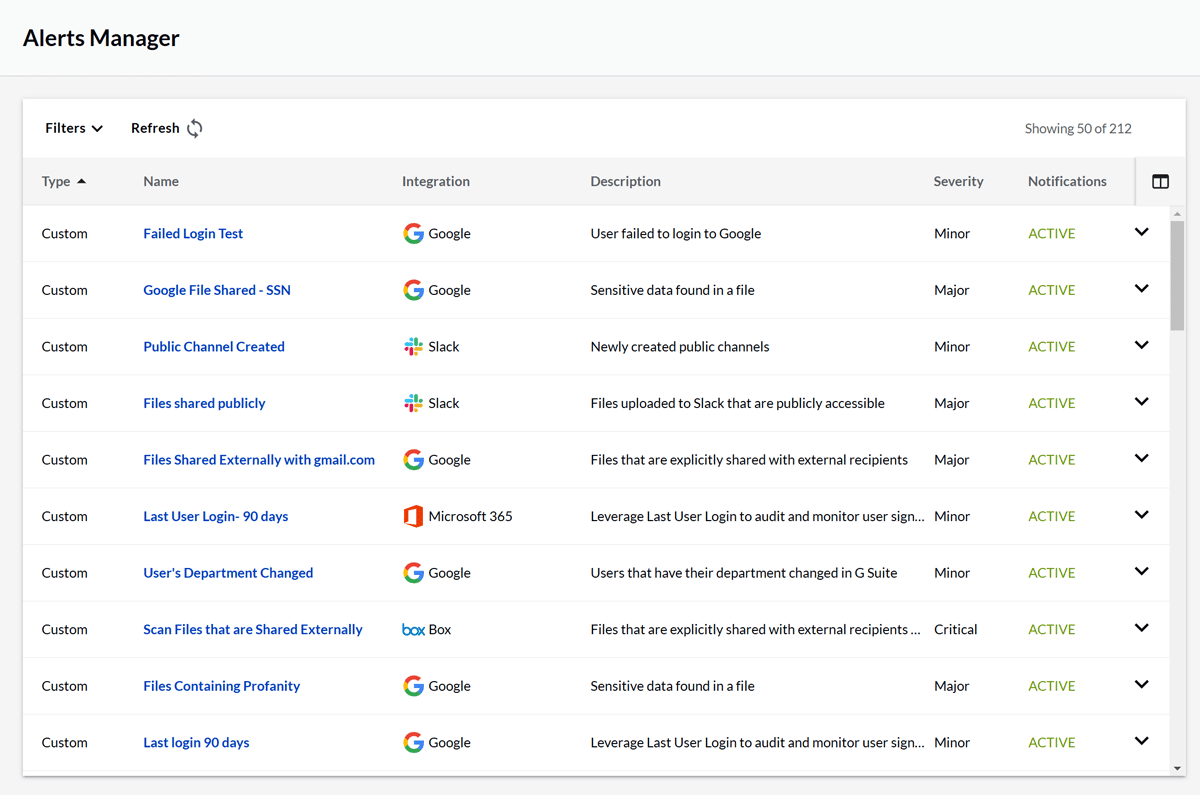
Data protection alerts commonly flag critical issues like:
- Group settings that allow anyone to post
- Email forwarding enabled, including to personal accounts
- Super admin additions, as nearly half of organizations experience this
- External file/folder sharing, affecting more than 20% of organizations
- Large file transfers over a short time or other risky behaviors
These alerts, which could point to insider threats or simple negligence, help your team respond quickly before small issues become major breaches.
4. Automated remediation of SaaS security incidents
When something goes wrong, speed matters. Platforms that support automated remediation of SaaS security incidents can revoke access, quarantine files, correct configurations, and roll back changes. All of these can dramatically reduce your mean time to respond (MTTR) while keeping clean audit trails for compliance.
So then the question becomes, what platforms support automated remediation of SaaS file security incidents?
Several categories of platforms can be deployed individually or together to deliver strong automated remediation, including SaaS security posture management tools and SaaS management and governance platforms with strong workflow automation capabilities.
Platform CategoryKey Remediation FeaturesStandout Capability
SaaS Security Posture ManagementToken revocation & session terminationBroad visibility + response
SaaS workflow Automation PlatformsOne-click & fully automated workflows with automated file link revocation and cleanupHigh-volume remediation
Integrated SOAR & OrchestrationCross-tool coordination & audit trailsEnterprise-scale operations
These platforms take quick action to efficiently close the loop from detection to resolution.
With these four core components working together, you have a solid framework. The next step is putting it into practice in your own environment.
Implementing data protection and SaaSOps in your Zero Trust journey
To maximize Zero Trust for SaaS success, follow these 5 steps.
Step 1: Assess & gain visibility
Start by understanding your data.
Know what sensitive SaaS data needs protection, who has access, assigned roles, and how data flows between apps, users, and devices. Conduct a full inventory and identify immediate blind spots.
Step 2: Define policies
Build standardized processes for user changes, temporary elevated access, compromised accounts, and automated alerts.
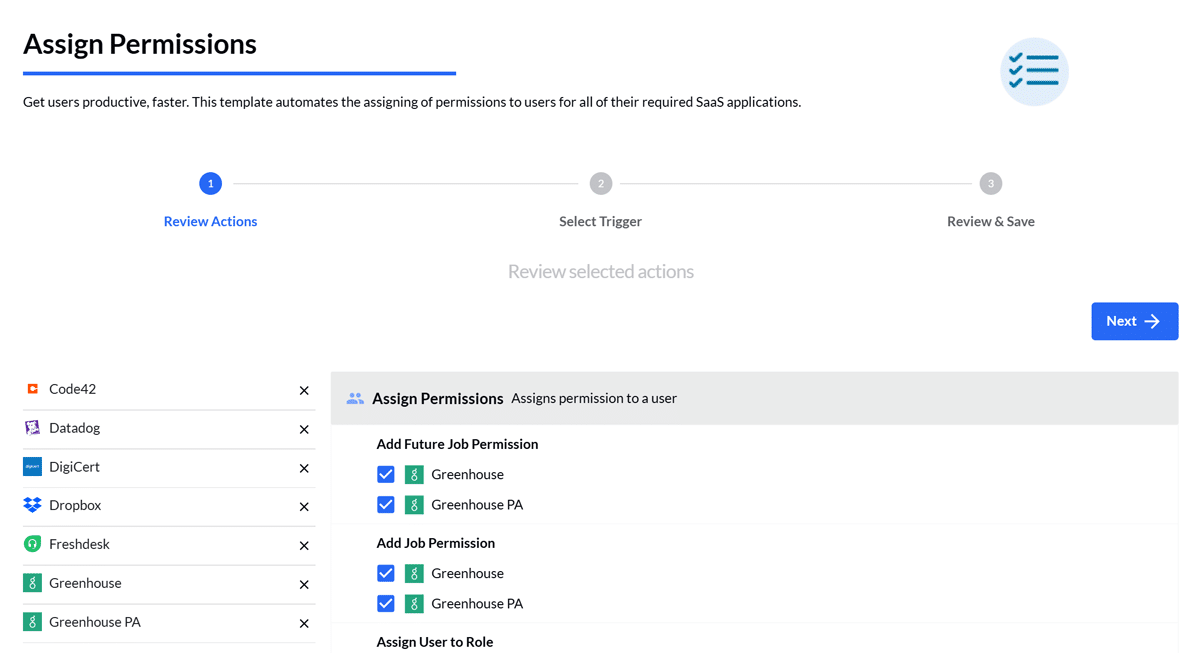
Set least privilege as the default and adjust trust dynamically — for example, when you see too many email forwards in a short period. Involve key stakeholders to ensure policies support both security and productivity.
Step 3: Activate governance & automation
Deploy SaaSOps with strong governance capabilities, integrate strong data access governance solutions, write your workflows and test your remediation playbooks. Start small with high-risk apps and expand from there.
Step 4: Measure and iterate
Track key metrics like reductions in exposed data, MTTR, compliance rates, and SaaS license optimization. Run regular drills so your team stays sharp and continuously refine your approach based on real-world results.
Step 5: Train and communicate
Invest in training to bridge any skills gaps and keep skills current. Change management is also key, communicate the benefits of Zero Trust for SaaS clearly to gain buy-in across the organization.
Set least privilege as the default and adjust trust dynamically — for example, when you see too many email forwards in a short period. Involve key stakeholders to ensure policies support both security and productivity.
Step 3: Activate governance & automation
Deploy SaaSOps with strong governance capabilities, integrate strong data access governance solutions, write your workflows and test your remediation playbooks. Start small with high-risk apps and expand from there.
Step 4: Measure and iterate
Track key metrics like reductions in exposed data, MTTR, compliance rates, and SaaS license optimization. Run regular drills so your team stays sharp and continuously refine your approach based on real-world results.
Step 5: Train and communicate
Invest in training to bridge any skills gaps and keep skills current. Change management is also key, communicate the benefits of Zero Trust for SaaS clearly to gain buy-in across the organization.
How a Zero Trust for SaaSOps workflow works

SaaSOps as the operational foundation of Zero Trust in SaaS
When a security incident hits, humans instantly become the bottleneck. After spotting an alert, IT or security log into multiple consoles and verify the threat. Once that’s done, manually revoking access can easily take hours, which is more than enough time for automated exfiltration scripts to walk out with your sensitive data.
In today’s threat landscape, automation isn’t a luxury. It’s survival.
Automate data protection alerts with AI-native solutions
That’s why data protection and AI-native SaaSOps tools are the practical foundation for making Zero Trust actually work in the SaaS era. Together, they deliver continuous visibility, dynamic governance, real-time automated alerts, and robust remediation — connecting everything into one unified system.
It’s never been easier, thanks to BetterCloud’s new AI-native tool complete with AI agents. They surface what’s happening, propose what to do, and execute only when you say so. Every action is logged, every policy is enforced and critically, nothing executes without your approval.
True Zero Trust demands automated, continuous enforcement
For real-time visibility and control across your SaaS applications, the only possible path is by using a SaaSOps tool built for SaaS governance. With this approach, you protect your most critical assets, slash risk, and eliminate manual operational burden — all without slowing the business down.
IT teams that embrace Zero Trust for SaaS see stronger data protection, faster incident response, smoother compliance, heightened security, and better SaaS ROI. Follow this roadmap and the benefits become very real and measurable.
Ready to strengthen your Zero Trust journey? Start with a thorough SaaS assessment and explore the right platforms for your needs. You’ve got this!
FAQs on Zero Trust for SaaS
What solutions help with SaaS data access governance?
Effective SaaS data access governance requires platforms that integrate directly into collaboration tools and SaaS apps via deep API connections. Rather than relying on inline network proxies, a dedicated SaaS Management Platform with strong automation and governance capabilities maps data access rights, surfaces over-privileged user accounts, and continuously audits nested file permissions to enforce a state of least privilege.
What platforms support automated remediation of SaaS security incidents?
Modern SaaS management platforms like BetterCloud stand alone in supporting automated remediation of SaaS security incidents. Instead of merely generating a static alert, these platforms utilize programmable, no-code workflow engines with AI agents to assist IT to instantly execute containment strategies—such as stripping public file links, suspending rogue OAuth sessions, and forcing global multi-factor authentication.
What solutions provide granular visibility into SaaS environments for enterprises?
SMP solutions provide the most granular visibility by aggregating and cross-referencing multiple discovery data streams. By combining data from Identity Providers (IdPs), endpoint management tools, financial/ERP records, and direct app APIs, these platforms give IT teams a comprehensive view of both sanctioned software and hidden Shadow IT.
What tools provide automated SaaS alerts for IT teams?
Automated SaaS alerts are driven by modern SaaSOps management layers and advanced cloud compliance systems. These tools continually scan the cross-application ecosystem for policy drift, behavioral anomalies, and security violations, pushing real-time alerts into central operations hubs like Slack, Microsoft Teams, or ITSM platforms.
What platforms help enforce MFA and SSO policies for SaaS apps?
Identity Providers (IdPs) and Identity-as-a-Service (IDaaS) suites—such as Okta, Microsoft Entra ID, and Google Cloud Identity—are the foundation for enforcing MFA and SSO. However, to guarantee these policies are applied universally, organizations pair them with a SaaSOps platform to flag applications that bypass the primary identity flow via side-door local account creation.
What solutions provide automated data loss prevention and file governance across multiple cloud apps?
Unified Data Loss Prevention (DLP) engines embedded within SMPs provide automated file governance. These tools, such as BetterCloud, scan for sensitive content strings (such as PII, credit card numbers, or proprietary code) and systematically enforce global security policies across multiple disparate platforms like Google Drive, OneDrive, Slack, and Box simultaneously.
How can IT teams automate SaaS admin permissions audits?
IT teams can automate permissions audits by configuring continuous compliance workflows within a SaaSOps platform. Instead of performing manual quarterly access reviews, these automated policies run scheduled evaluations that instantly flag and remediate instances of “privilege creep,” such as standard users gaining unapproved super-admin roles.
What is the role of workflow automation in SaaS governance?
Workflow automation transforms SaaS governance from a reactive checklist into a real-time, proactive security posture. Because human response times cannot match the speed of cloud-based data movement, workflow automation ensures that critical lifecycle steps—like user offboarding, file containment, and access revocation—happen instantly, consistently, and without human error.

