Untangling AI: A 7-Category Schema for B2B SaaS


AI is not one thing. It’s at least seven different conversations happening simultaneously (and conflating them makes every discussion less productive)
Every week, someone walks into a meeting and says “AI is going to change everything.” The problem isn’t that they’re wrong, it’s that the statement is meaningless without specificity. A marketer worried about losing search traffic to Google’s AI Overviews is having a fundamentally different conversation than a CFO evaluating whether a $200/month AI tool can replace a $200K/year software contract. A developer using AI to ship code faster has nothing in common with a Wall Street analyst panic-selling SaaS stocks.
As a lender to hundreds of private B2B SaaS companies, SaaS Capital sees how these trends affect real revenue, not in theory, but in actual monthly recurring revenue data. In my role as a marketer, I am hands-on with AI, seeing the benefits, the downsides, and the general confusion. What we’ve found is that productive AI conversations require separating the topic into distinct categories, each with different stakeholders, different timelines, and very different risk profiles.*
This initial framework breaks “AI” into seven distinct categories that affect B2B SaaS companies differently:
For each category, we define what it actually is, what the perceived risks are, and how accurate those risks are based on current data. The goal: when someone says “AI,” you can identify which of seven different conversations they’re actually trying to have.
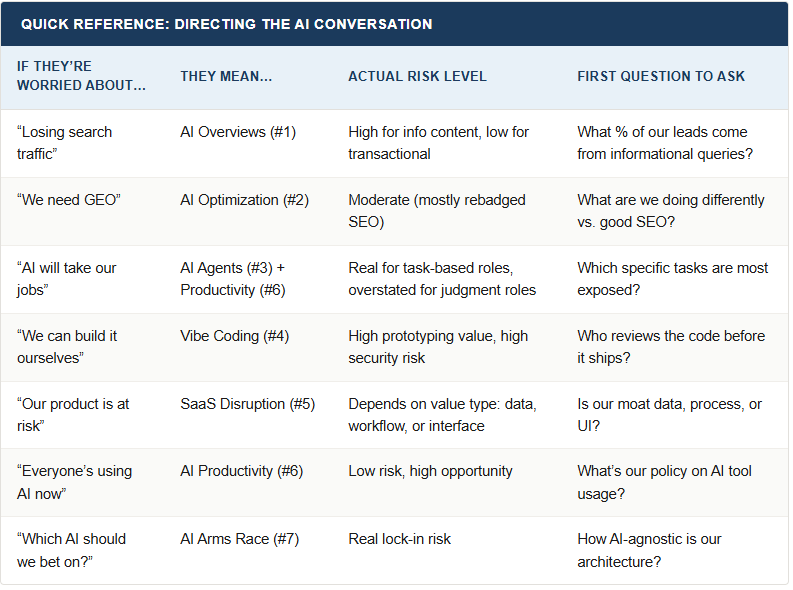
Quick Reference: Directing the AI Conversation
Category 1
AI Overviews: The Search Traffic Problem
- What It Is: Google’s AI-generated summaries at the top of search results, synthesizing information from multiple sources and answering queries directly on the SERP.
- Who It Affects: Content marketers, publishers, and B2B companies relying on organic search traffic. Companies with content-driven acquisition funnels are particularly exposed.
- Current Scale: Informational queries trigger AI Overviews roughly 50%+ of the time. The top 50 global domains account for nearly 30% of all AIO citations, led by Reddit, Wikipedia, Quora, and YouTube.
The Data
The numbers have gotten worse since the early studies. Ahrefs’ December 2025 data (300K keywords) shows a 58% reduction in CTR for the top-ranking result when an AI Overview is present, up from 34.5% in April 2025. Zero-click rates for AI Overview queries hit 83%. Only 1% of users click on sources cited within AI Overviews. Perhaps most telling: 26% of users leave Google entirely after reading the AI Overview, compared to 16% in traditional search results.
Risk Assessment
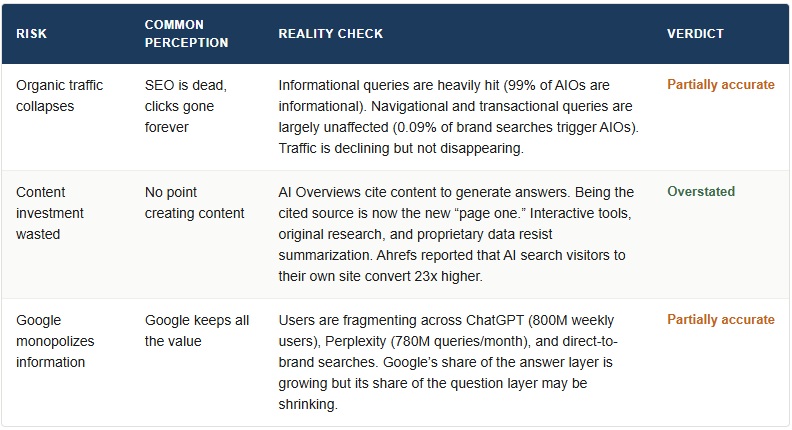
Key nuance for SaaS companies: The impact is overwhelmingly on informational, top-of-funnel content. If your acquisition strategy depends on ranking for “what is [category]?” queries, you’re exposed. If it depends on product-led content, comparison pages, calculators, or proprietary research, the impact is far less severe. Original data and interactive tools are essentially AI-proof because they can’t be summarized into a text box.
Category 2
AI Optimization: GEO / AEO / AIO vs. SEO
- What It Is – Optimizing content to be cited, referenced, or recommended by AI systems, including Google AI Overviews, ChatGPT, Perplexity, and Claude. Known by multiple acronyms: GEO (Generative Engine Optimization), AEO (Answer Engine Optimization), AIO (AI Overview Optimization).
- Who It Affects – Marketing teams, content strategists, SEO professionals, and agencies positioning themselves to sell these services.
- Current State – A growing cottage industry of vendors and consultants claiming GEO is fundamentally different from SEO and requires specialized expertise and tooling.
The Honest Assessment
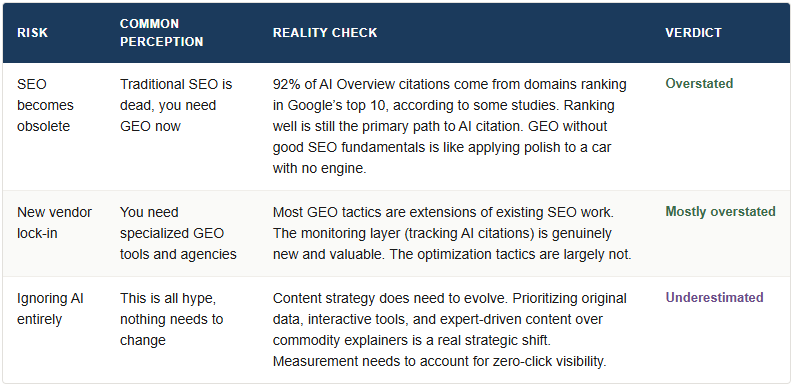
There is a meaningful conversation to be had about optimizing for AI citation. The problem is that much of the current GEO/AEO industry is selling anxiety rather than genuine differentiation. Here’s what’s actually different and what isn’t:
What’s genuinely new: Monitoring whether your brand is cited in AI-generated answers across multiple platforms (ChatGPT, Perplexity, Google AIOs). Measuring “AI Share of Voice” as a distinct metric. Understanding that only 12% of URLs cited by ChatGPT rank in Google’s top 10. This means the citation game has different rules than the ranking game. Structured data and schema markup matter more than they used to.
What’s just good SEO with a new name: Creating authoritative, well-structured content. Building topical depth and expertise signals. Publishing original research and data. Making content easy to parse and extract. These have been best practices for a decade. (More on this here.)
Risk Assessment
Category 3
AI Agents: Task Automation and Workflow Replacement
- What It Is – AI systems that don’t just answer questions but perform multi-step tasks autonomously: filing documents, organizing data, conducting research, drafting deliverables, managing workflows.
- Who It Affects – Knowledge workers, SaaS companies whose products automate specific workflows, services companies that sell human labor for tasks AI can now do.
- Key Example – Claude Cowork with industry plugins (legal, finance, sales, marketing) that can automate contract review, compliance workflows, financial analysis, and document management.
The Data
This is where the stock market panic lives. When Anthropic released industry-specific plugins for Claude Cowork in early February 2026, the S&P 500 software and services index fell nearly 9% over five trading sessions. Thomson Reuters dropped 15.83% in a single day. LegalZoom fell nearly 20%. An ETF tracking the software industry had its worst day since April 2025.
The fear is straightforward: if an AI agent can do contract review, financial analysis, or data marketing for a fraction of the cost, why pay for specialized SaaS tools or expensive professional services?
Risk Assessment

Key nuance for SaaS companies: The threat level depends entirely on what your software does. If your product’s core value is organizing, searching, or synthesizing information, you’re highly exposed. If your value is in workflow orchestration across complex systems, regulatory compliance, or multi-party coordination, you have more runway. The Gartner analyst’s observation is telling: “People are just surprised by the sheer pace of innovation… I thought this was going to happen in 2027.”
Category 4
AI-Assisted Coding (Vibe Coding)
- What It Is – Using natural language to describe what you want built and having AI generate functional code. The term was coined by Andrej Karpathy in February 2025 and named Collins Dictionary’s Word of the Year. You describe the “vibe”; the AI writes the code.
- Who It Affects – Software developers, non-technical founders, product managers, and any business that pays for custom development. Early reports shows 92% of US developers trying AI coding tools.
- Current Scale – 41% of all global code is now AI-generated. 87% of Fortune 500 companies have adopted at least one vibe coding platform. 63% of vibe coding users are non-developers.
The Tension
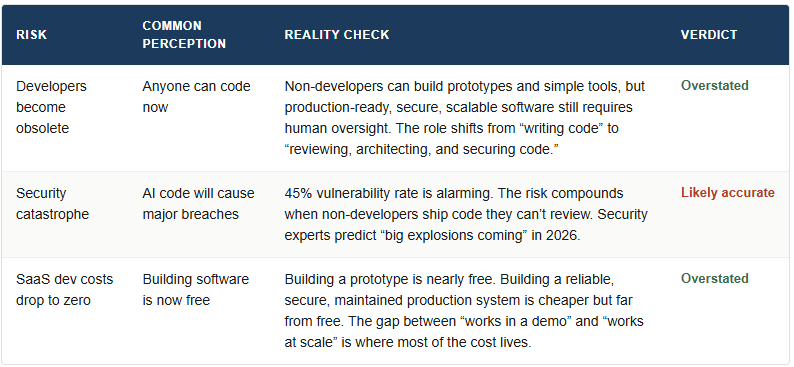
Vibe coding is simultaneously the most productive and most dangerous AI category. The productivity gains are real: 26% improvement in overall work completion speed, up to 81% faster for routine tasks like API integration and boilerplate code. At the same time, 45% of AI-generated code contains security vulnerabilities, code churn is 41% higher, and developer trust has dropped from 77% favorability in 2023 to 60% in 2025.
Fast Company reported the “vibe coding hangover” has arrived, with one analyst predicting $1.5 trillion in technical debt by 2027 from AI-generated code. Security experts are comparing the risk of unreviewed AI code in production to the Challenger disaster.
Risk Assessment
Category 5
AI as SaaS Disruption Vector: The Cowork Effect
- What It Is – The emerging threat that general-purpose AI tools could replace specialized, vertical SaaS products. Not just adding AI features to existing software, but AI becomingthe software.
- Who It Affects – SaaS founders, investors, and anyone whose business model depends on selling recurring software subscriptions. Particularly data/research tools, legal tech, financial analysis, and productivity software.
- The Trigger – Claude Cowork industry plugins (Feb 2026) triggered a trillion-dollar selloff. Opus 4.6’s multi-agent teams and expanded context window deepened the fear.
Why This Matters Differently Than Category 3
Category 3 (AI Agents) is about task automation (AI doing individual jobs). This category is about business model disruption (AI replacing the need for entire product categories). The distinction matters because the risk calculus is different. A company can adopt AI agents and become more efficient. But if AI replaces the need for the SaaS product you sell, efficiency doesn’t help.
The Bull Case: Jefferies analyst Brent Thill argues the selloff is overblown because highly regulated industries won’t rip out compliance-integrated, mission-critical systems. Existing SaaS companies have time to integrate AI. The “build vs. buy” calculation still favors buying for complex, domain-specific workflows.
The Bear Case: LPL Financial’s Thomas Shipp noted that non-technical users are now “empowered to replace existing workflows” that previously required specialized software. Salesforce is down 26% year-to-date in 2026, making it the second-worst performing stock in the Dow. Salesforce’s own CEO said the company won’t be hiring additional software engineers, customer service agents, or lawyers because of AI.
The key question for SaaS companies: Is your product’s value in the data, the workflow, or the interface? If it’s the interface (making something easier to see or do), AI will likely replicate that. If it’s the workflow (complex multi-party processes with compliance requirements), you have time. If it’s the data (proprietary information users can’t get elsewhere), you’re defensible.
Category 6
AI-Enhanced Productivity: The Quiet Revolution
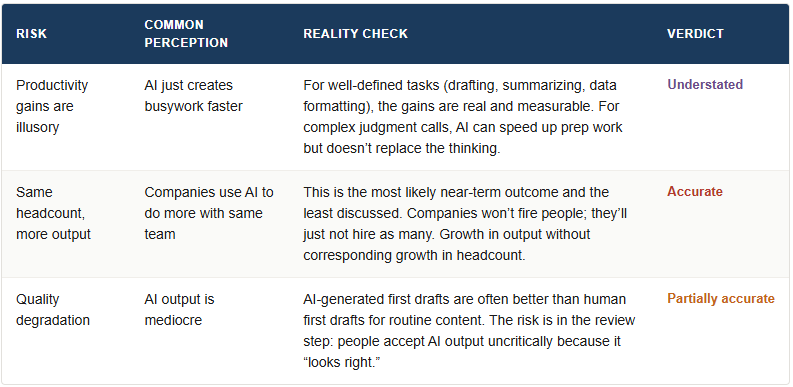
- What It Is – Using AI tools to make existing workers more productive: drafting emails, summarizing documents, creating presentations, analyzing data, researching topics. The “boring” AI (i.e., not replacing anything, just making people faster).
- Who It Affects – Every knowledge worker. This is the most broadly applicable and least controversial category.
- Current State – Opus 4.6 expanded its context window to 1M tokens, can coordinate teams of AI agents, and includes direct PowerPoint integration. The model targets “production-ready” output requiring less human intervention.
Risk Assessment
Category 7
The AI Arms Race: Models, Funding, and Market Dynamics
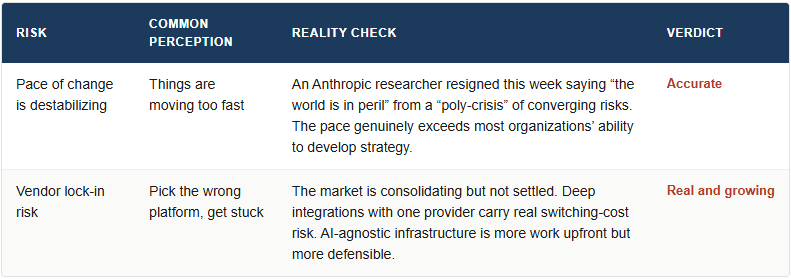
- What It Is – The competitive race between Anthropic, OpenAI, Google, Grok, and others to build more capable AI models, raise massive capital, and capture market share.
- Who It Affects – Investors, enterprise buyers choosing platforms, and anyone building long-term strategy on AI tools that may radically change every 6–12 months.
- Current State – Anthropic’s $13B raise at $183B valuation. Over 300,000 business customers. Opus 4.6 outperforming GPT-5.2 on professional task benchmarks. The Gartner analyst quote: “I thought this was going to happen in 2027.”
Risk Assessment
The Meta-Risk: Treating AI as One Thing
The biggest risk in AI discussions isn’t any single category, it’s treating them all as the same phenomenon. A board member who reads about the Cowork stock selloff and concludes “AI is killing SaaS” is making a different error than a marketer who dismisses GEO as hype and ignores the 58% CTR decline in AI Overview queries.
Productive AI conversations start with specificity. Which AI? Affecting what? For whom? Over what timeframe? This framework doesn’t answer every question, but it should prevent you from accidentally conflating seven different conversations into one unresolvable argument.
Sources
AI Overviews & Zero-Click Search
Claude Cowork, Opus 4.6 & SaaS Stock Impact
Vibe Coding
Analyst & Executive Quotes
- Mark Murphy, JP Morgan – on the “illogical leap” of extrapolating Cowork to replacing all enterprise software. Via Futurism/Reuters.
- Brent Thill, Jefferies – on regulated industries unlikely to rip out compliance-integrated systems. Via Marketplace/APM.
- Thomas Shipp, LPL Financial – on non-technical users empowered to replace workflows. Via CNN Business.
- Arun Chandrasekaran, Gartner – on the surprising pace of AI innovation. Via Marketplace/APM.
- Dario Amodei, Anthropic CEO – on AI displacing half of entry-level white-collar jobs. Via ABC News.
- Marc Benioff, Salesforce CEO – on not hiring additional engineers, CS agents, or lawyers due to AI. Via CNN Business.
- Mrinank Sharma, Anthropic researcher – resignation and “world is in peril” warning. Via Investing.com.
- Dianne Penn, Anthropic – on Opus 4.6 as an “inflection point for knowledge work.” Via CNN Business.
- David Mytton, Arcjet CEO – on catastrophic risks from unreviewed vibe-coded apps. Via The New Stack.
- Ed Yardeni, Yardeni Research – on software stocks being “hard hit” with ambiguous long-term impact. Via ABC News.
*In keeping with the subject matter, this article was written with assistance from one of the AI tools it discusses. The framework, categories, and point of view are mine, shaped by years of working alongside B2B SaaS companies, but ultimately reflecting my personal opinions, not anyone else’s. Claude helped with research, data gathering, and drafting. I reviewed and edited everything, but I’d be a hypocrite if I wrote a piece about AI’s impact on knowledge work and pretended I didn’t use it. This is also a first iteration. The categories and risk assessments made sense as of February 2026. By the time you read this, some may already need updating. That’s sort of the point. As with any rapidly evolving topic, specific statistics should be verified against the original sources, which are cited at the end of the article.